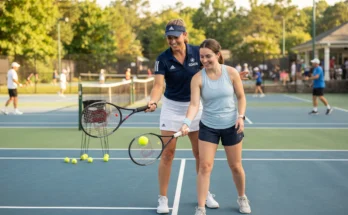

The professional racquet sports landscape is experiencing a massive talent migration right before our eyes, as some of the biggest names in tennis history are officially trading their baseline grinding for the glass-walled confines of the padel court.
What started as a casual crossover has rapidly transformed into a legitimate competitive pipeline, drawing both active ATP champions and retired Grand Slam winners into a sport that is completely rewriting the rules of court supremacy.
This isn’t just a brief offseason hobby for elite athletes looking to blow off steam. The transition represents a fundamental shift in the racket sports ecosystem. For decades, tennis players facing the twilight of their careers had two options: the broadcast booth or the senior tour.
Now, they are finding a second athletic life in a game that demands less physical ground to cover but requires an entirely new, hyper-strategic approach to angles, teamwork, and wall mechanics. It matters because this influx of world-class hand-eye coordination is supercharging the sport’s global popularity.
According to recent reports and industry tracking from Ascaro Padel and international equipment hub TiendaPadelPoint, the wave of tennis crossovers is being spearheaded by heavyweights like Rafael Nadal, Novak Djokovic, and Gaël Monfils.
These reports highlight that the walled-in game, while sharing historical roots with the world’s oldest racket sport, is drawing pros away from the larger court to avoid injury and, quite frankly, bring the pure fun back into their training regimens.
The Physical Relief and Strategic Shift
To understand why this is happening, you have to look at the brutal physical toll of professional tennis. The ATP and WTA tours are notorious meat grinders. You are isolated on a massive island of hardcourt, clay, or grass, sprinting side-to-side for four hours while absorbing the shock of 130-mph serves.
Padel offers an entirely different geometric puzzle. The court is significantly smaller, reducing the physical demands. Because it is almost exclusively played in doubles, athletes are suddenly sharing the physical and mental load.
But do not mistake a smaller court for an easier game. The transition is notoriously tricky. Tennis players are hardwired to hit clean winners past their opponents. In the 20×10-meter glass box, hitting a ball with max power often means it simply bounces off the back wall and sits up perfectly for your opponents to smash it back down your throat.
The reports from Ascaro Padel note that a strategic approach and immense discipline are required so these elite athletes do not resort to their ingrained tennis mechanics. Using the walls and mastering partner coordination are absolute necessities.
Legends Finding a Second Wind
The list of converts reads like a tennis hall of fame ballot. Rafael Nadal didn’t just casually pick up a racket; he heavily invested in the growth of the sport by opening a dedicated academy in his hometown of Manacor in Mallorca, Spain.

When a 22-time Grand Slam champion puts his infrastructure and brand behind a sport, the rest of the world takes notice. Novak Djokovic and Gaël Monfils have also integrated the sport into their lives, using quick volleys and rapid reflexes to keep their hands fast and their minds sharp.
On the women’s side, the crossover has been even more pronounced at the highest levels of competition. Former WTA stars like Marta Marrero, alongside Pilar and Maria Jose Sanchez Alayeto, haven’t just played exhibitions; they have completely hung up their traditional rackets to dominate the glassed-in courts.
In fact, a significant portion of today’s top-ranked female players entered the professional circuit after finding initial success in tennis. They brought their elite conditioning and baseline power.
For retired players, the sport has become a fountain of youth. Take Daniel Nalbandian, the fiercely competitive Argentinian who reached the Wimbledon final and ranked as high as No. 3 in the world.
In 2018, Nalbandian made his official debut on the professional circuit at the Open 300, securing a smashing victory against established players Mauro Plenasio and Ezequiel Ojeda. Fellow former tennis titans Guillermo Canas and Juan Carlos Ferrero have also made the jump, frequently appearing in World Padel Tour tournaments over the past several years.
The Gear and the Global Takeover
This mass migration has completely altered the equipment industry as well. When you have players who are used to the precise tension of a custom tennis string job switching over to carbon-fiber paddles, the gear has to evolve. Brands have had to step up to meet the demands of athletes who know exactly what world-class equipment should feel like.
TiendaPadelPoint highlights that specialized brands are currently engineering rackets specifically tailored for this demographic. Products like the Alacran Aker and Alacran Heka are specifically designed to help aggressive, power-heavy tennis players transition into a game that requires delicate drop shots and spin control.
The equipment needs to balance the raw power these athletes generate with the finesse required to keep the ball from flying out of the enclosure. It is a delicate engineering dance, and the influx of tennis money and attention is driving massive innovation in racket technology and court construction.
The media impact of these crossovers cannot be overstated. When a player like Nadal or Ferrero steps onto the court, they bring millions of tennis fans with them. International Pro-Am tournaments and charity exhibitions featuring legends from both sports are serving as the ultimate gateway drug for fans. Observers tune in to see their favorite retired tennis player and end up mesmerized by the frantic, squash-meets-tennis rallies that define the modern game.
What Comes Next for the Sport
So, where does this racket revolution go from here? The crossover pipeline is only going to widen. As the financial purses for international tournaments continue to grow, we will likely see tennis players making the switch earlier in their careers. Instead of waiting until their knees can no longer handle the ATP tour, players ranked outside the top 100 in tennis might realize they can make a better living by transitioning to the glass box in their athletic prime.
Expect governing bodies to push heavily for Olympic inclusion, using the star power of these tennis crossovers as leverage to prove the sport’s global television appeal. The walls are closing in on traditional racket sports, and right now, all the momentum is bouncing off the glass.
Want to know about the top Padel Players in the World?
If you’re watching tennis stars step into padel, you’ll naturally wonder who actually dominates this sport right now. The modern game is led by elite names shaping tactics, speed, and teamwork at the highest level. To understand the real competitive landscape, explore our detailed guide on the top 10 padel players in the world, where rankings, playing styles, and rising stars reveal how the sport is evolving beyond its tennis roots.