
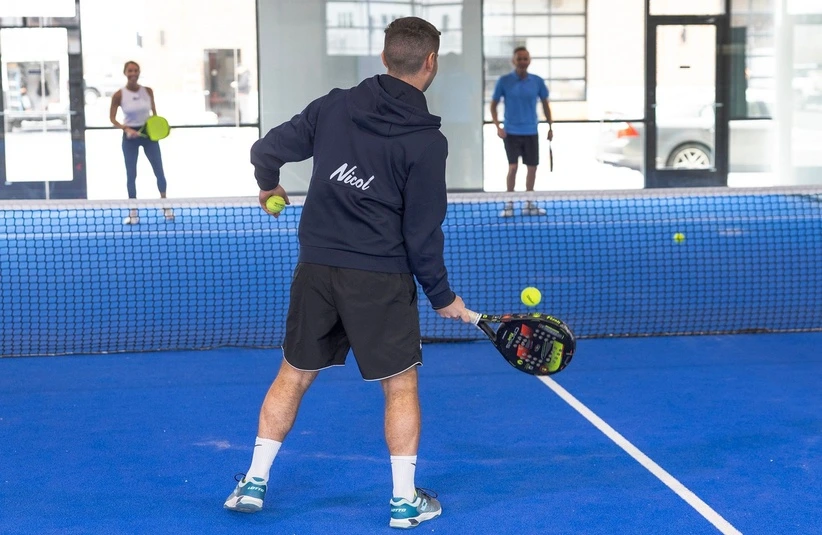
Padel fans in the United Kingdom received a major update regarding the sport’s highly anticipated summer calendar. London Premier Padel P1 is officially set to take over the historic Olympia this August.
The arrival of the prestigious P1 tier represents a seismic shift for the fast-growing sport in the British market. This is not just another standard tour stop; it is the ultimate proving ground for a racket sport trying to plant its flag in a city already saturated with world-class summer athletics. For a game that has quietly built a rabid grassroots following, a P1 tournament is the moment the sport steps out of the shadows and onto the main stage.
According to the Lawn Tennis Association and latest dispatches from The Padel Paper, the six-day spectacle will run from August 4 through August 9, 2026. Pre-sale tickets for LTA Advantage members became available in late April, followed immediately by a general sale through Ticketmaster that has already seen more than 10,000 tickets snapped up by eager fans.
A Step Up in Class and Scale
To understand the magnitude of the London event, you have to look at the current landscape of the professional circuit. The Premier Padel Tour is divided into distinct tiers, with Majors and P1 events sitting comfortably at the top of the ranking points, prize money, and overall prestige.
While P2 events deliver exceptional competition, P1 tournaments are where everything naturally reaches new heights. These are the flagship moments of the tour, designed to feel entirely premium. The stakes are simply higher, the international broadcast reach is wider, and the player fields are noticeably deeper.
The recent Brussels P2 event served as a perfect appetizer for what the United Kingdom is about to experience. Held in a converted industrial warehouse in the heart of Belgium’s capital, the tournament showcased the very cultural shift that event organizers hope to replicate in West London.
The crowds in Brussels arrived in waves. First came the mildly curious, then the committed local players, and finally the completely converted. By the time the Sunday finals rolled around, there was not a single empty seat remaining in the venue.
That natural evolution of a crowd, from intrigued observers to heavily invested fanatics, is something the sport does better than almost any other emerging athletic competition. People who walk through the doors planning to watch a single match inevitably find themselves staying for hours, learning the tactical nuances of the glass walls, and studying the calendar for future tour dates.
The Olympia Factor
Bringing this circus to Olympia is a deliberate and calculated move. The newly renovated venue is not just another convention hall; it is one of London’s most recognizable architectural landmarks. Having hosted premium events for nearly 140 years, Olympia recently completed a massive £1.3 billion transformation. Dropping a state-of-the-art Padel court into the middle of that setting instantly gives the tournament a heavy sense of occasion.
It also changes the way fans interact with the environment. Unlike traditional tennis majors, where crowds are largely tethered to a single assigned seat for hours, padel events operate more like a bustling campus. Movement is highly encouraged. Spectators at Olympia will have unassigned seating across the outer courts, allowing them to drift freely, pause at matches they never planned to watch, and build their own unique rhythm for the day. When it is time for the main event, the lights on center court will dim, the music will swell, and the environment will instantly shift from a casual festival into a heavyweight title fight.
A Different Kind of Sporting Atmosphere
The crowd dynamic at a padel tournament is a fascinating case study in modern sports consumption. The fans do not behave like the traditional, library-quiet crowds found at Wimbledon, nor do they carry the relentless, aggressive tribalism of a Premier League football match.
They exist somewhere right in the middle. There is a deep, instinctual respect for the rhythm of a long rally, but the reactions to a spectacular defensive retrieval or a thunderous smash are loud, loose, and incredibly relaxed.
During the Brussels P2, that unique atmosphere reached a fever pitch. As the finals approached, the venue took on a palpable tension. When Juan Lebron and Leo Augsburger orchestrated a brilliant comeback win over the world number ones, the crowd response was less of a polite applause and more of a total eruption. Similarly, when Bea Gonzalez and Paula Josemaria secured their third consecutive title on the women’s side, the audience was entirely caught up in the historical weight of their growing dominance.
That shared emotional experience is exactly what event producers are aiming for in London. The actual quality of the matches is almost a given at this level; it is the shared experience of watching the drama unfold that ultimately lingers with the ticket buyer.
Premium Production Value
London is a city that does not hand out free passes to live events. With world-class sport, music, and theatre competing for disposable income every single weekend, any new arrival needs to deliver a flawless product. To ensure the London P1 meets those lofty expectations, the execution is being handled by Sela, a heavyweight in the live event production space.
Sela recently produced the massive Tyson Fury versus Arslanbek Makhmudov fight night in London, showcasing its ability to handle major logistical challenges while delivering an elite atmosphere. Their involvement ensures that the Olympia tournament will not be just a sporting competition but a holistic entertainment property. From the hospitality suites to the outer-court sightlines, the infrastructure is being designed to deliver a new market of fans the premium experience they expect from top-tier international athletics.
Expanding the Inner Circle
One of the most compelling storylines heading into August is how the British crowd will merge with the sport’s traveling diehards. At every major stop on the tour, a recognizable inner circle of fans is present. These are the spectators who follow the circuit across borders, instantly recognize the mid-tier players, and obsessively monitor the ever-changing doubles partnerships. They move through the venues with total purpose, discussing previous tournament results and tracking ranking points.
When the doors open at Olympia, this established community will mix with thousands of British first-timers. The sport is famously accessible to newcomers, with the court’s geometry and the use of the glass walls becoming intuitive after just a handful of rallies. The points are constructed perfectly and contain enough to hold the attention of a modern sports fan.
The ultimate goal for the London Premier Padel P1 is not just to sell out Olympia for six days in August. The objective is to firmly establish the UK as a mandatory, premier destination for the sport’s biggest stars for the next decade. Up next, the world’s top players will spend the remainder of the summer fine-tuning their hardcourt strategies on the European mainland.


One Comment on “Premier Padel’s London P1 Event Set to Transform UK”