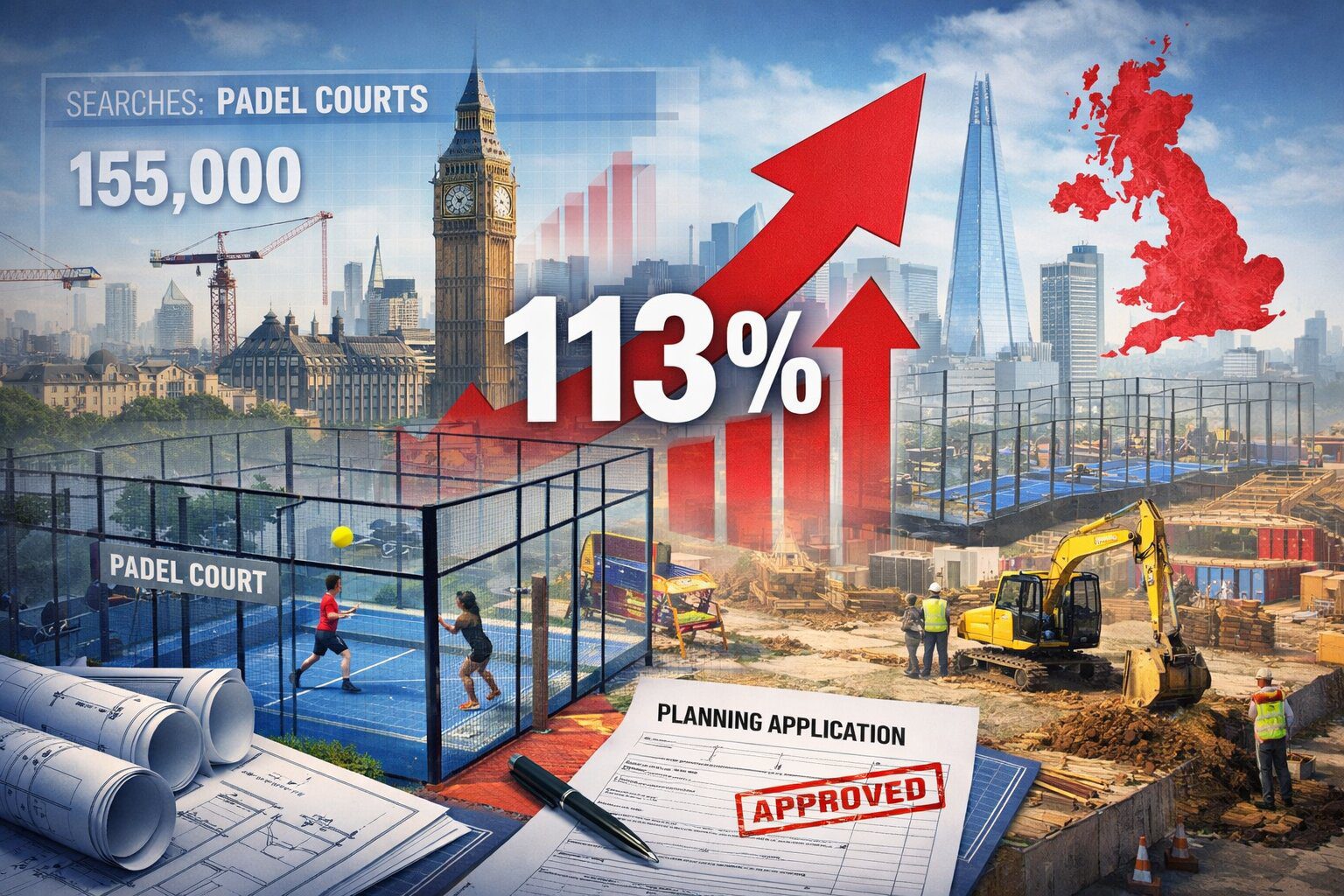
The UK padel boom has taken another big step forward. Planning applications for padel courts jumped 113% in 2024, according to figures cited by the London Daily News from Searchland. The growth is impressive on its own. The bigger story, however, is what sits behind it. Demand for courts is rising faster than the planning system can handle. Investors, leisure operators, and councils are all trying to catch up with a sport that has quickly moved from niche to mainstream.
This matters because padel is no longer a niche activity for racket sports fans. It is becoming an increasingly significant part of the UK leisure landscape. Clubs are reporting waiting lists and peak-time shortages.
Commercial demand is also rising, while online interest continues to grow. If this pace continues, pressure will increase across the board. Clubs will need to build more courts, and planning authorities will need to process more applications. They must also balance community concerns and expansion speed.
London Daily News reported that applications rose from 53 in 2021 to 544 in 2025. The outlet also cited research from Planning By Design. Searches for “padel” reached 13 million in January 2026, up 47% year over year. Searches for “padel courts” hit 155,000, up 190%. In short, demand is very visible. It appears in planning pipelines, on Google, and in everyday conversations as people try to book courts.
Why the UK padel boom is accelerating
One key reason for the sport’s rapid growth is its accessibility. Padel is beginner-friendly, social, and needs less space than tennis. This makes it easier to build in urban and suburban areas. Space is limited in these locations, so efficiency matters. The sport also appeals to different age groups. Unlike some fitness trends, it does not fade quickly.
There is also a broader lifestyle shift happening. After the pandemic, people value health and social connections more. Community-based activities have gained importance. Padel fits perfectly into this trend. It offers competition without requiring high skill levels. It also attracts both regular players and beginners. This makes it easier for clubs to keep courts busy.
The Lawn Tennis Association has already recognized this momentum. London Daily News quoted Tom Murray, LTA Head of Padel, calling 1,000 courts a major milestone. This number reflects strong participation and growing investment. It also shows rising public interest across the country.
Planning pressure is now part of the story
Interest is the easy part. Planning is where challenges begin. The same report highlighted common obstacles. These include noise concerns, lighting issues, and visual impact. There are also restrictions on protected land and complications with site usage. Traffic and parking concerns add further complexity.
These challenges are not unusual. However, the scale of applications makes them harder to manage. Aaron Basi from Planning By Design explained that the system must keep pace with demand. Councils must balance growth with community needs. They are not just approving courts. They are deciding how expansion affects local areas.
Basi also noted that planning systems were not built for this speed. Developers who prepare early have better chances of approval. Clear strategies for noise, lighting, and transport are essential. This highlights a key issue. Planning systems are designed to assess impact, not react to sudden trends.
Planning pressure is now part of the story
Rapid growth brings another risk. Speed can lead to poor construction. When demand is high, quality sometimes suffers. London Daily News cited concerns raised at the UK Padel Convention. Some courts are being built incorrectly due to the rush.
One example involved a failed installation described as a “big fish tank.” Around £50,000 was wasted, and the only solution was to rebuild. This type of mistake can damage investor confidence.
It also adds another layer to the issue. Planning is not the only challenge. Developers must also deliver high-quality courts. Poor drainage, bad lighting, or noise issues can quickly create problems. A strong market means little if the final product fails.
That is why early planning matters. Experts recommend acoustic studies, community engagement, and proper transport planning. Lighting design and policy alignment are also important. In simple terms, preparation should come before submission.
Where the biggest opportunities are
Despite challenges, the growth potential is huge. Planning By Design identified nearly 17,000 possible development sites. These include sports venues, commercial properties, and community spaces. Searchland data highlighted over 16,000 leisure sites with potential for expansion.
This suggests that future growth may rely on existing locations. Adapting current facilities could reduce some planning issues. However, challenges will still exist. Usage changes, transport concerns, and policy conflicts remain important factors.
Key cities for development include London, Bristol, Edinburgh, Leeds, and Manchester. London leads due to its size and demand. However, the broader list shows nationwide interest. This is not limited to one region.
What happens next for the UK padel boom
The next phase depends on execution. Demand is strong, and the sport has clear momentum. However, delays or poor-quality builds could slow progress. Even fast-growing trends can face setbacks.
For now, the outlook remains positive. The pipeline is expanding, and interest continues to rise. The planning system, however, is under pressure. Developers who prepare well will have an advantage. Those who engage communities early will also benefit.
Right now, everyone wants a court. The real challenge is building the right ones, in the right way.
New to Padel? Start with the 2026 Beginner Guide
If you are just getting into padel and wondering where to start, it helps to have a clear foundation before stepping onto the court. From understanding basic rules and scoring to choosing the right racket and positioning, the learning curve becomes much easier with the right guidance.
That is exactly where our Padel Beginner Guide 2026 comes in. It breaks everything down in simple terms so you can move from complete beginner to confident player without feeling overwhelmed. As more courts open across the UK, having this knowledge early will help you make the most of every game and avoid common beginner mistakes.
Frequently Asked Questions (FAQs)
1. What are the metrics saying about the UK padel surge?
According to the data, the applications for padel courts have increased by 113%. The trajectory has a four-year period between 2021 and 2025, where the applications have surged from 51 in 2021 to 544 in 2025.
2. What is the search engine saying about the demand for padel courts in the UK?
According to search engines (mainly Google), the word ‘padel’ reached a search volume of 13 million in January 2026. On the other hand, long-tail keywords like ‘padel courts’ have increased to 155,000.
3. What are the points that you don’t approve of about padel courts?
The biggest point of disapproval is the noise impact. The voice of solid carbon and the surrounding glass walls can become a permanent distraction for the neighborhood. There can be light pollution, especially during lighting hours, when many floodlights are required to ensure the best possible experience for the players.