Padel is rapidly cutting into the player base of traditional tennis. LTA‘s infrastructure expansion roadmap has pushed Britain past the 1,000-court threshold. It has driven a structural paradigm shift in which new athletic demographics are abandoning traditional baselines in favor of the fast-paced security of glass walls.
This explosion in club conversions across major metropolitan areas matters because it strips away the century-old monopoly that tennis has maintained over premium athletic real estate and private-club revenue models. For decades, tennis stood as the uncompromising gold standard of baseline endurance, technical execution, and physical isolation.
The Impact of Padel
Padel completely overhauls this onboarding friction by shrinking the court geography. It trades traditional string configurations for solid carbon-fiber impact bats and converts structural boundaries into playable surfaces. This design choice lowers the performance floor for novice players. It shifts the competitive metric from pure kinetic force to geometric positional awareness, optimizing spatial economics for club owners.
The physical and mechanical dividing lines are officially tracked by the LTA, alongside Babolat and the global sports supplier Decathlon. These industry authorities point out that while both sports share a common lineage and use the same arithmetic scoring framework, the mechanical reality separates them the moment the ball leaves the racket.
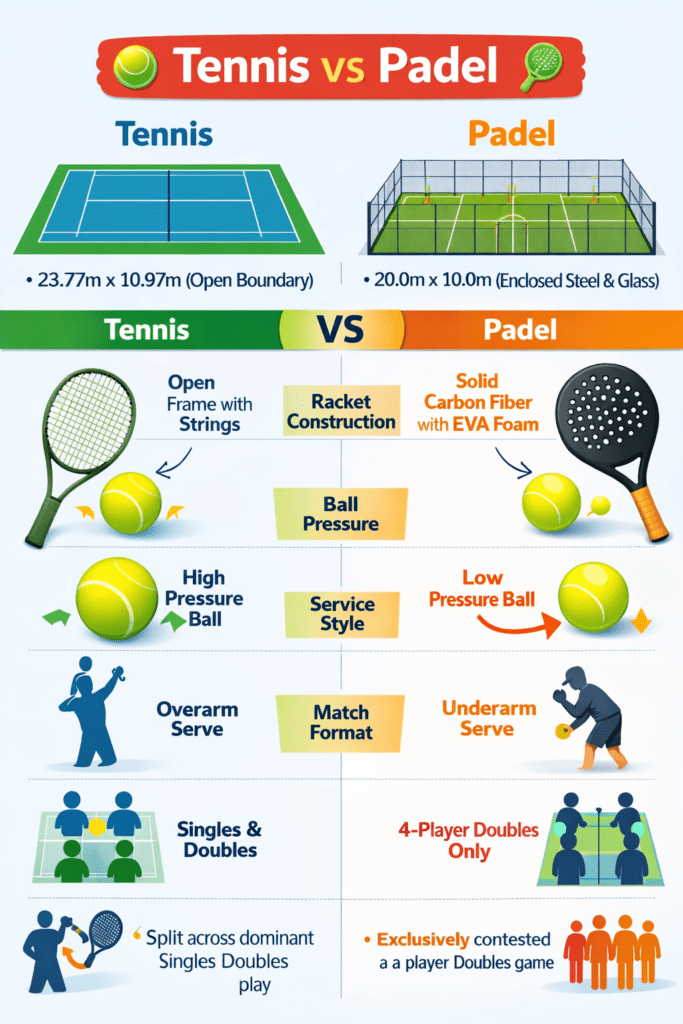
The LTA notes that raw surface dimensions establish distinct cardiorespiratory profiles. A padel installation requires a hyper-focused 20-meter-by-10-meter footprint. On the other hand, a traditional tennis court demands a sprawling 23.77-meter-by-10.97-meter layout that taxes raw linear acceleration.
Decoding the Structural Foundations
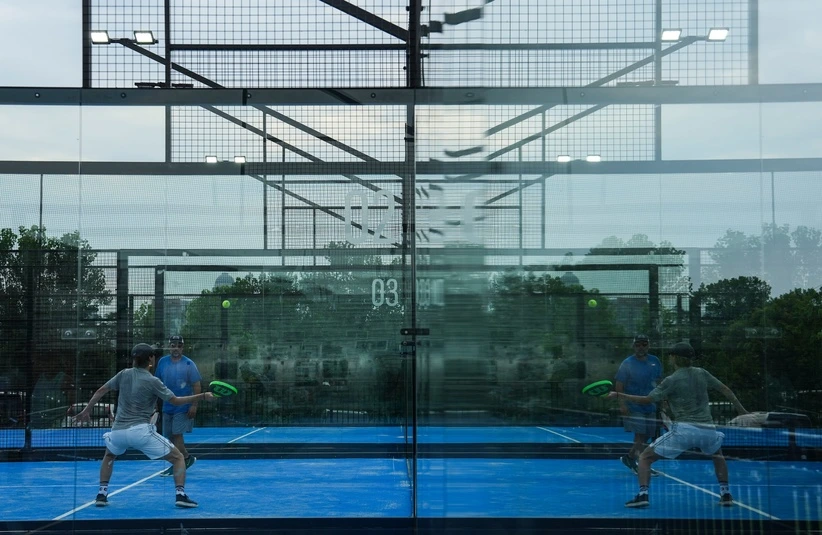
To assess the structural realities of padel vs tennis, you have to break down the internal engineering of the gear. In standard tennis, lines on a court represent definitive competitive boundaries. Once a shot lands beyond the perimeter of white tape, the rally is dead. Padel rejects this limitation by weaponizing a structural cage forged from reinforced structural steel mesh and thick tempered glass panels.
While the ball must always make contact with the turf surface before touching any part of the perimeter, the rear and side glass modules act as live defensive mirrors. Instead of turning and sprinting backward into deep recovery positions to chase down a heavy topspin loop like a tennis baseline player, a padel competitor intentionally lets the ball race past. He monitors the trajectory as it ricochets off the rear glass. He turns the physical bounce into a controlled, tactical reset.
The Mechanics of Tennis
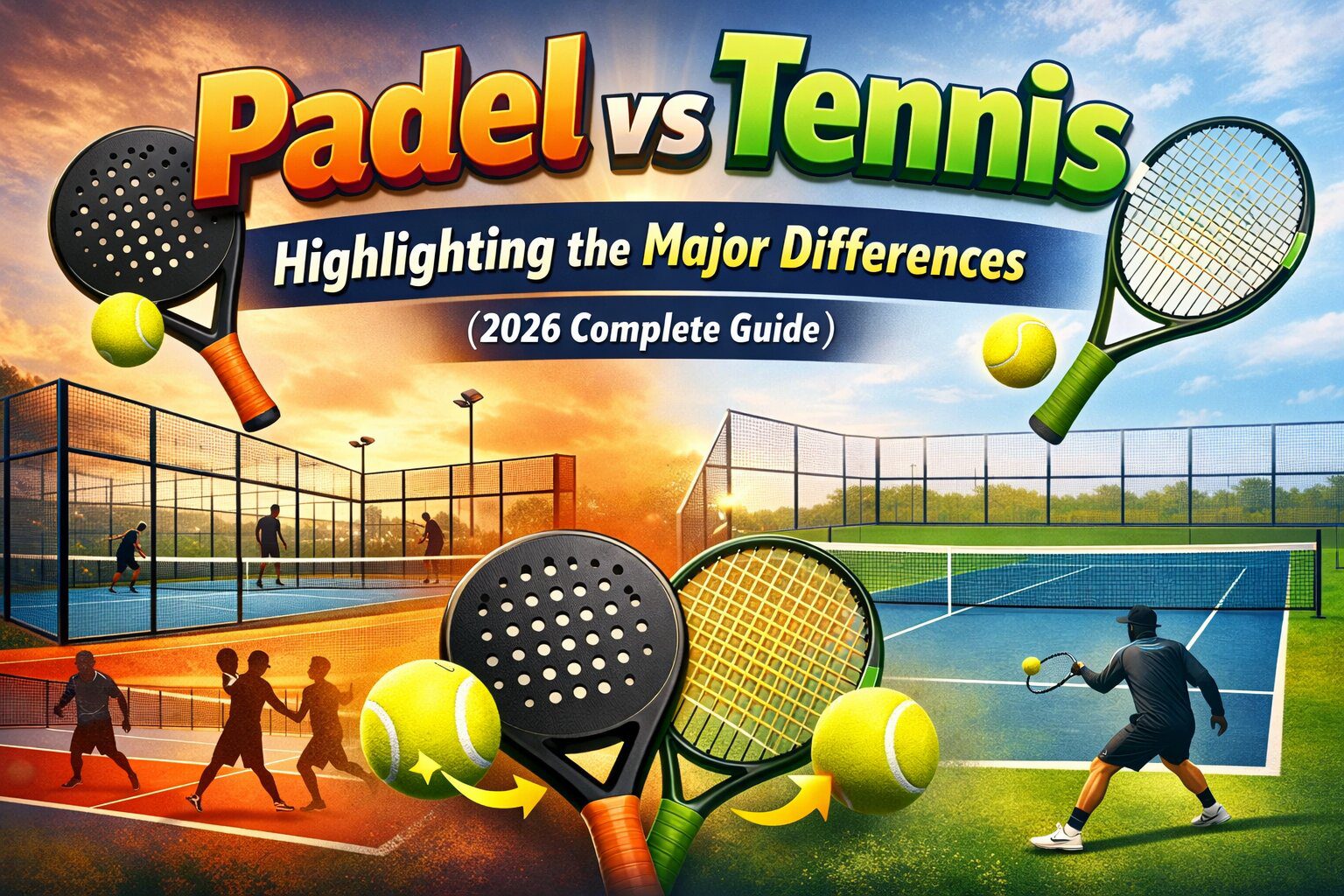
A tennis racket has an open hoop woven with high-tension synthetic fibers. It extends up to 27 inches to generate massive trampoline physics for heavy, dipping baseline velocity. Conversely, padel bats are entirely stringless, structurally solid, and constructed from high-grade carbon fiber composites over a dense elastomeric EVA foam core, with a uniform thickness of 38 millimeters. The structural face is heavily perforated with custom-drilled airflow channels. This minimizes the drag coefficient during rapid recovery movements.
Even the core engineering of the balls features distinct internal physics. However, they look completely identical on retail shelves due to matching high-visibility felt coatings. The LTA’s equipment testing confirms that padel balls are intentionally designed with a lower internal air pressure than tennis balls. This intentional drop in atmospheric pressure keeps the ball from flying out of control within the smaller dimensions. This prevents the action from turning unplayably chaotic in close quarters.
The Technical Conflict
The tactics required to control a padel match are the opposite of the mechanics taught to youngsters in tennis academies. Inside the lines of a tennis court, raw terminal velocity and ultra-aggressive court positioning are heavily rewarded. A massive first serve or an explosive overhead smash from the deep baseline is engineered to be a definitive point-ending strike. It renders the opponent unable to lay out a counter-response.
If you attempt to copy that exact maximum-force mentality onto a padel court, you will rapidly surrender games. Because the playing zone is highly compressed and boxed in by glass, a high-velocity smash often transfers so much energy into the back wall that it rebounds directly over the net.
Shot Dynamics
Instead of hunting for immediate point-ending power, elite padel requires a disciplined embrace of structural geometry, patient positioning, and what master coaches label the “slow game.” LTA performance metrics indicate that padel shots must remain compact and low to the ground, with a heavy focus on executing cutting spins that cause the ball to skid and die upon striking the rear wall. This environment has sparked the creation of specialized ball strikes that simply cannot be replicated with a tennis racket:
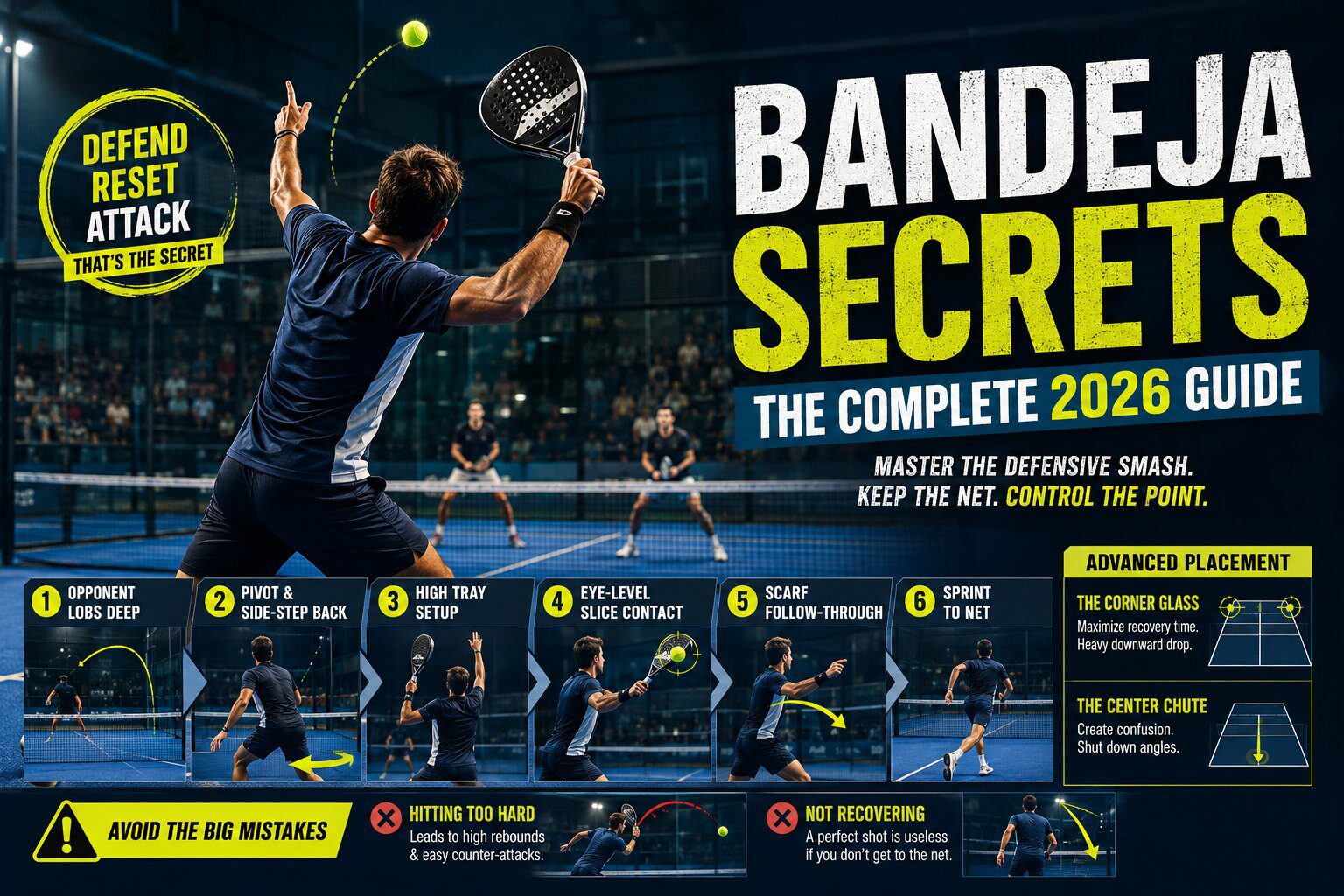
- The Bandeja: A highly controlled, mid-court hybrid overhead struck with heavy backspin, executed to pin charging opponents deep in their defensive corners while reclaiming control of the net.
- The Bajada: A quick, descending down-force smash struck directly out of a high, deep bounce off the rear glass, turning an opponent’s high lob into an aggressive downward attack.
- The Vibora: A highly advanced side-spin overhead that causes the ball to curve aggressively through mid-air and slide instantly off the side mesh, making a clean defensive block nearly impossible.
Tennis rules permit vertical ball tosses and maximum-effort overarm serves hit from an elevated plane. It regularly produces unreturnable aces that cross at triple-digit miles per hour. Padel strictly outlaws overarm serving. This requires the server to drop the ball and strike it at or below waist height after a single bounce behind the baseline line.
The Cultural Shift and the Reality of Crossover Athletes
The massive global boom of padel is changing career paths for tennis veterans. As the physical toll of covering a full-sized singles tennis court becomes biologically unsustainable for athletes with age, padel offers a second window.
The LTA notes several high-profile athletic transitions. It is highlighted by the career arc of Spanish superstar Marta Marrero. Marrero reached a singles ranking of world No. 47. Moreover, she made the quarterfinals of Roland Garros before chronic ankle injuries halted her career. By adapting it to the demands of the glass court, she secured the world No. 1 ranking in padel.
Frequently Asked Questions (FAQs)
1. What is the difference between a padel court and a tennis court?
Ans: A padel relies on a hyper-focused 20-meter-by-10-meter footprint. Meanwhile, tennis has a 23.77-meter-by-10.97-meter layout.
2. How does a defensive wall impact the defensive strategy in padel compared to tennis?
Ans: In tennis, the baseline is the boundary line where your shot is eligible. So, basically, the moment the ball goes past you, the point is over, mostly unless the ball has backspin and you can get to it before it bounces twice. A padel player intentionally lets a fast ball go past him so that it deflects back from the glass and enables you to hit a controlled return.
3. How do padel balls differ from tennis balls despite looking exactly the same?
Ans: The only similarity a padel and a tennis ball has is the appearance. Both are yellow. According to the LTA stats, padel balls have a low internal air pressure. Hence, the ball bounces, and its speed is lower than that of a tennis ball.
4. Why is a powerful smash a bad idea in padel?
Ans: As we said previously, a defensive wall ensures that the ball reflects with the same speed and power as it gets hit. Hence, a powerful smash means that the ball is coming your way at a similar speed, and all your opponent needs is some sort of connection.
5. What are Bandeja, Bajada, and Víbora, and why aren’t these shots tennis-related?
Ans: Bandeja is an overhead strike with spin to ensure that your opponents go deep to retrack the ball, as the ball doesn’t have any speed. The Bajada is an overhead that rebounds from the rear glass. Vibora is an overhead that skids from the side mesh. Tennis doesn’t have a functioning wall, so any overhead is basically the end of the point (especially at the net).